

Training interoception for athletes is one of the most overlooked keys to peak performance — and it starts long before game day.
The night before the big game. The morning of the championship meet. The hour leading up to your first varsity start.
Your stomach is doing something. Your heart has opinions. Your palms have apparently developed a new hobby.
Welcome to the feeling every serious athlete knows — and almost nobody talks about honestly.
We call it nerves. We call it anxiety. We call it “getting in our own head.” And somewhere along the way, we decided it was a problem to be solved, a weakness to be hidden, a signal that something has gone wrong.
What if we’ve had it backwards the whole time?
The Gift You Didn’t Know You Were Receiving
Here’s a reframe worth sitting with: the fact that you feel anything before competition is actually remarkable.
It means you care. It means this matters. It means you have, as they say, skin in the game.
Think about the alternative for a moment — showing up to compete and feeling absolutely nothing. No flutter, no electricity, no heightened awareness. If that were the case, it might be worth asking whether this is truly the right sport, the right team, the right season of your life to be doing this at all. The absence of feeling isn’t calm. It’s disconnection.
Those nerves you’re trying to quiet? They are your body gearing up. They are your system recognizing that something significant is about to happen and mobilizing every resource it has to help you meet it. That’s not sabotage. That’s preparation.
For any athlete, developing interoception — the ability to hear what your body is actually saying — is where performance work gets real. The question isn’t how do I make this stop?
The question is how do I listen to what this is telling me?
Your Body Speaks First — Your Brain Just Interprets
To understand why this matters so much for athletes, it helps to know a little about what’s actually happening inside you in those pre-competition moments.
You’ve probably heard of the gut-brain connection. But most people imagine it as a two-way walkie-talkie where the brain calls most of the shots. The science tells a different story.
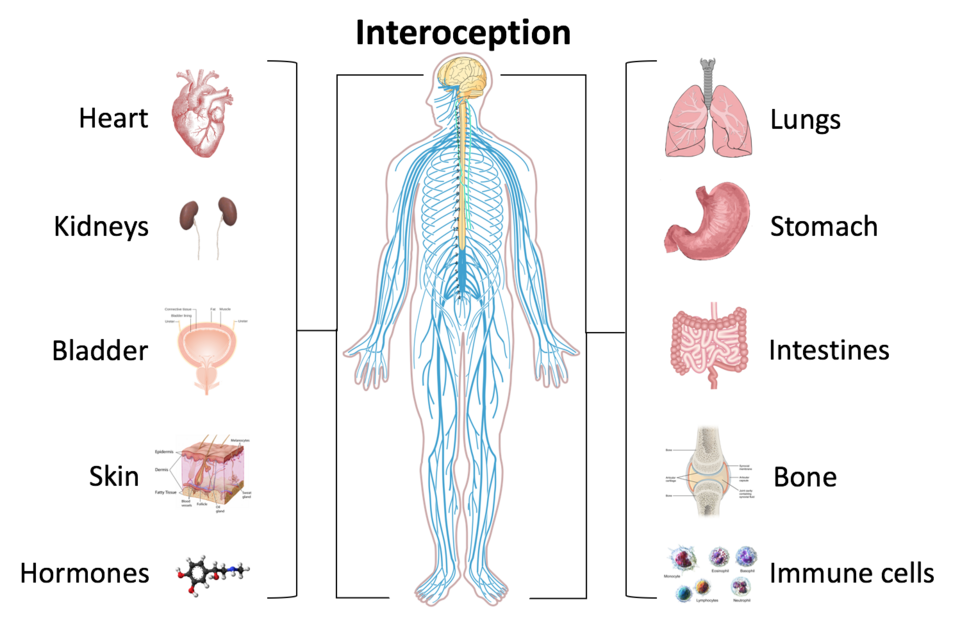
The vagus nerve — the long, wandering nerve that connects your brainstem to your heart, lungs, and digestive system — is the primary highway of this communication. And according to research published in Frontiers in Neuroscience, roughly 80% of its nerve fibers carry signals upward, from the body to the brain. Only about 20% travel the other direction.*
Read that again. Your body is sending four times more information to your brain than your brain is sending back down.
This means that the butterflies in your stomach, the tightening in your chest, the strange focused clarity (or foggy overwhelm) you feel before competition — these are not your brain malfunctioning. They are your body reporting in. Your gut, your heart, your nervous system are all sending dispatches upward, and your brain is making sense of them — interpreting them as excitement or dread, readiness or panic, depending on a thousand factors including the story you’ve been telling yourself about what those sensations mean.
This is powerful information. Because if the body speaks first, then learning to hear your body clearly — and accurately — becomes one of the most important skills an athlete can develop.
That skill has a name.
Interoception: The Sense You Never Knew You Were Training
You’re probably familiar with our five classic senses — sight, hearing, touch, taste, smell. You may even know about proprioception, the sense that tells you where your body is in space (crucial for any athlete).
But there’s another sense that doesn’t get nearly enough attention: interoception.
Interoception for athletes is one of the most underleveraged performance skills in existence. It is your ability to perceive what is happening inside your body. It is the felt sense of your own internal landscape — a constant stream of information from your organs, muscles, tissues, and nervous system that tells you what is happening beneath the surface.
It sounds abstract. But you experience it constantly. Interoception is:
- Noticing that your heart rate has picked up before you consciously register that you’re nervous
- Feeling the heaviness in your legs that tells you you’re running on empty before your performance drops
- Sensing that something is “off” in your body during warmups, even when you can’t name it yet
- The awareness that your breathing has gone shallow when the game gets tight
- Recognizing the difference between muscle fatigue and the kind of tired that means you need to stop
- Knowing, somewhere in your chest, that you’re actually ready — even when your mind is telling you a fear story
- That specific feeling in your gut right before a peak performance moment — the one athletes describe as “being in the zone”
- Noticing tension held in your jaw, your shoulders, your hands during high-pressure moments
- The internal signal that you’re dehydrated before thirst kicks in
- Sensing your own focus sharpen as game time approaches
Every one of those is interoception in action. And here’s what’s remarkable: this is a trainable skill.
Most athletes spend enormous energy developing their external skills — speed, strength, technique, strategy. High-performing athletes increasingly understand that their internal skills are just as trainable, and just as essential.
Why Interoception Is a Competitive Edge
When your interoceptive awareness is well-developed, several things become possible that simply aren’t available to athletes who haven’t cultivated this skill:
You stop misreading your own signals. Pre-competition activation feels different from actual anxiety. Productive tension feels different from harmful stress. When you can distinguish between these clearly, you stop fighting sensations that are actually working in your favor.
You catch problems earlier. Fatigue, overtraining, the early stages of an injury — all of these have internal signals that arrive before external performance changes. Athletes with strong interoception catch them sooner.
You can regulate more effectively. This is why building interoception for athletes is a core part of the mental performance work I do. You can’t work with a sensation you can’t feel. Breathwork, hypnosis, EFT tapping, visualization — all of these tools become significantly more powerful when paired with clear body awareness, because you’re working with real-time information rather than guessing.
You access flow states more reliably. The “zone” that athletes describe — that state of effortless, high-performance focus — is deeply connected to the body. Athletes who know how to tune inward can learn to recognize the internal conditions that precede peak performance and, over time, to cultivate them intentionally.
The Inner Game Starts on the Inside
Sports are a magnificent mirror for life. The pressure you feel before a big game is the same pressure you feel before a difficult conversation, a career leap, a performance review, a relationship milestone. The nervous system doesn’t distinguish between a championship meet and a moment that feels like one.
The athlete who commits to developing interoception for athletes — who learns to hear their body clearly — isn’t just becoming a better competitor. They’re becoming a more self-aware, self-regulated human being. And that carries forward into every room they walk into, long after their playing days are over.
This is where the real work begins. Not in trying to eliminate what you feel before the game, but in learning to listen to it with skill. f you’re curious how these tools work in practice, you can learn more about my approach to mental performance work at Pepper Tree Wellness.
In the posts ahead, we’ll explore specific tools and practices — breathwork, hypnosis, EFT tapping, and more — that work directly with the body’s internal signals to help athletes (and humans) perform at their best when it matters most.
For now, the invitation is simple: the next time you feel something before a big moment, get curious instead of concerned. Your body is speaking. It might have something important to say.
* Source: Breit, S., Kupferberg, A., Rogler, G., & Hasler, G. (2018). Vagus Nerve as Modulator of the Brain–Gut Axis in Psychiatric and Inflammatory Disorders. Frontiers in Psychiatry, 9, 44. https://doi.org/10.3389/fpsyt.2018.00044
